Highland Rim · Cumberland Plateau · Cultural borderland
Where Middle Tennessee meets Appalachia
Center Hill Lake sits in Middle Tennessee on the Highland Rim, close to the western edge of the Cumberland Plateau. Its culture draws from Appalachian and Upper South traditions without fitting neatly inside a tourist stereotype of either region.
Old-time music, bluegrass, quilting, pottery, blacksmithing, woodworking, church singing, hunting, farming and food preservation all belong here. So do contemporary artists, electric tools, new residents and ideas arriving from beyond the region. A living culture is allowed to evolve.
Public galleries · Working studios · Tennessee Tech
The Appalachian Center for Craft
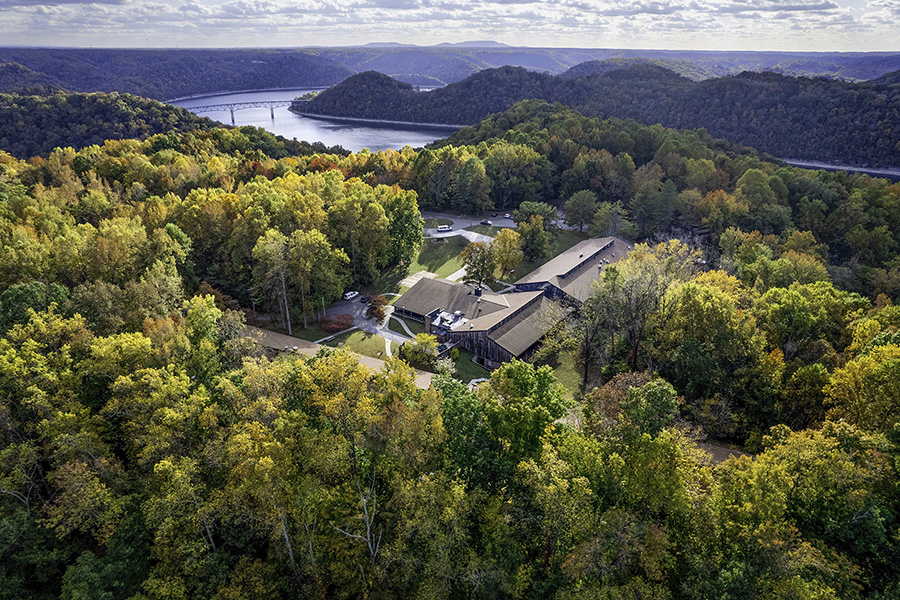
Opened in 1979 and now part of Tennessee Tech University, the Appalachian Center for Craft overlooks Center Hill Lake from the Highland Rim. It combines academic programs, exhibitions, workshops, studios and a sales gallery representing regional makers.
Clay, fibers, glass, metals, wood and blacksmithing appear side by side. That matters: the Center does not treat craft only as a vanished domestic necessity. It shows how inherited techniques become contemporary art, design and livelihoods.
Check current gallery hours, exhibitions and workshop registration before visiting. Demonstrations and studio access vary by program.
Old-time music · Dance · Courthouse square
Smithville’s Fiddlers’ Jamboree
Smithville’s Jamboree began in 1972 and grew into a major gathering for old-time Appalachian music, dance and craft. Tennessee designated it the state’s official jamboree and crafts festival, but its importance is easier to hear than to summarize: different generations meet on the same square and test living skill in public.
Fiddle, banjo, singing, buck dancing and string-band competition connect the event to community music made long before commercial country music moved through studios and radio. The craft booths extend the same idea into objects made by hand.
The Jamboree is annual, so confirm the current year’s dates and rules through the official organizer and check Upcoming Events for Tony’s trip-planning notes.
Gardens · Preserving · Mills · Community tables
Foodways are practical knowledge
Regional food traditions grew from seasonality, limited cash, farm labor and the need to preserve what a household produced. Cornmeal, beans, greens, cured meat, pickles, sorghum and fruit preserves are not merely a rustic menu; they are records of climate, work and adaptation.
Today those traditions appear in farm stands, markets, bakeries, church meals and small producers. Quality varies, and “local” is not automatically historic. Ask who made an item, where its ingredients came from and whether the business is interpreting a tradition or simply borrowing its image.
Muddy Pond · Churches · Rural work
Visit communities without turning people into exhibits
Mennonite businesses around Muddy Pond offer food, leatherwork and other goods within a living religious community. They can be part of a worthwhile regional day trip, but residents are not performers and the community is not an open-air museum.
Dress and act respectfully, visit public businesses during posted hours, avoid photographing people without permission and remember that Sunday closures and religious practice are not inconveniences designed for visitors.
Continue with Tony’s existing Muddy Pond community day-trip guide.
Craft Center · Smithville · Local food
A culture day that makes sense
Start at the Appalachian Center for Craft while galleries are open. Return to Smithville for the courthouse square and local businesses, then choose a meal or producer that adds a specific connection to the region.
If the Jamboree, Celebration of Craft or another major program overlaps with your dates, let that event anchor the day. Otherwise, the Craft Center remains the strongest interpretive stop and the surrounding towns supply the everyday context.